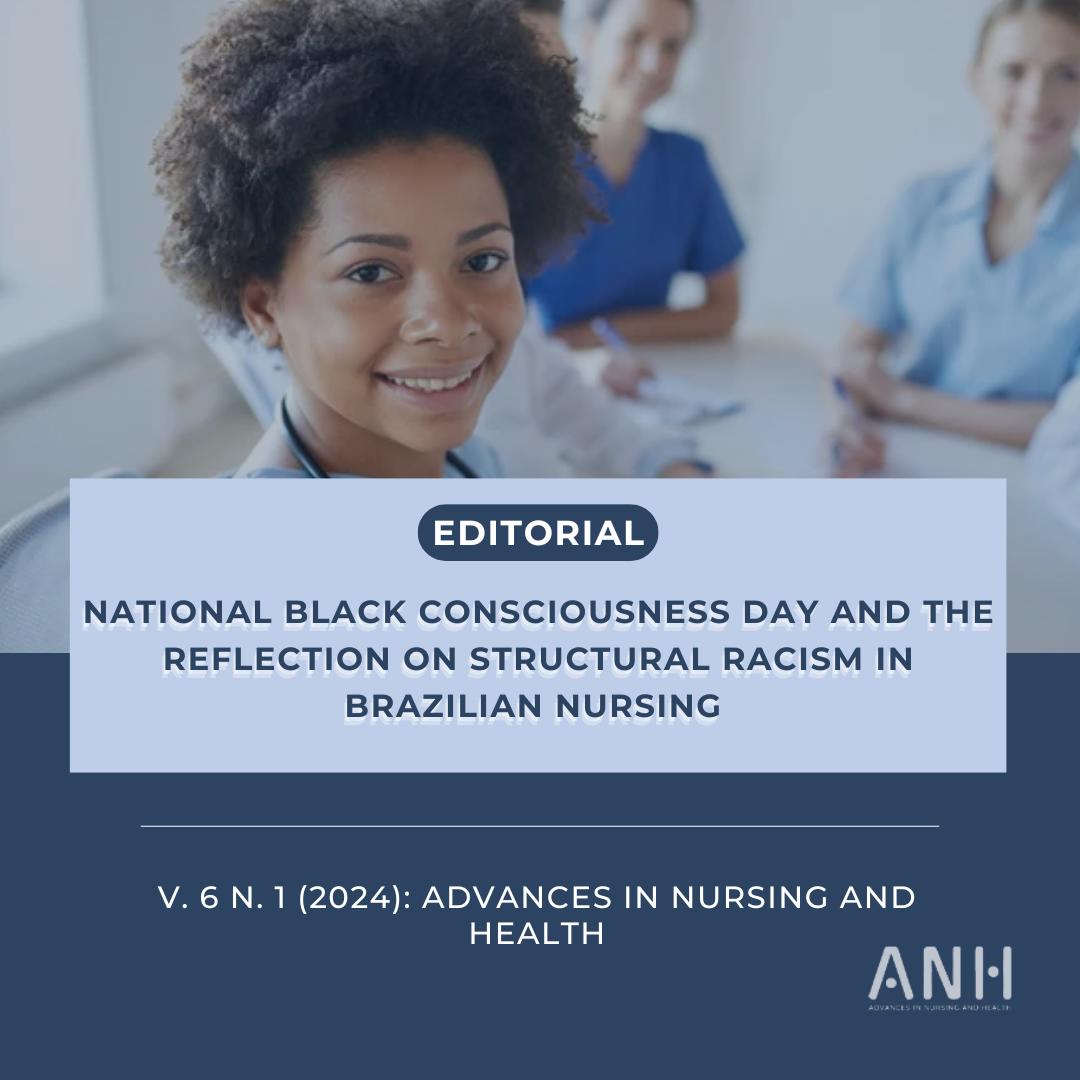
National black consciousness day and the reflection on structural racism in brazilian nursing
Structural racism in Brazilian nursing
DOI:
https://doi.org/10.5433/anh.2024v6.id51343Keywords:
Nursing; Black or African American; Systemic Racism; Universities; Public PolicyAbstract
National Black Awareness Day calls on nursing to reflect on policies to reduce social and racial inequality in Brazil. In recent decades, affirmative policies, such as democratized access to higher education for black, brown, indigenous people and public school graduates, have been developed, transforming the participation of black people in universities. However, even with the increase in black graduates, challenges persist in terms of visibility and prestige. Preliminary data shows that the majority of nurses in the south of Minas Gerais identify as white, despite more than 50% of Brazilian nursing staff being black, predominantly at technical levels. The low presence of black nurses in senior positions, influenced by race variables, highlights institutional racism. It is necessary to promote discussions and research to combat structural racism and increase black representation in higher-level nursing jobs.
Downloads
References
Carvalho RA. As representações sociais de cotas para negros por egressos do curso de graduação em enfermagem de universidades públicas [tese]. Rio de Janeiro: Universidade do Estado do Rio de Janeiro; 2023. 209p.
Machado MH, coordenador. Perfil da enfermagem no Brasil: relatório final. Rio de Janeiro: NERHUS - DAPS - ENSP/Fiocruz; 2017. 748p.
Published
How to Cite
Issue
Section
License
Copyright (c) 2024 Simone Albino da Silva, Juliana Aparecida Pacheco Moreira (Autor)

This work is licensed under a Creative Commons Attribution 4.0 International License.
All or the content of the newspaper is licensed under a Creative Commons Attribution License, of the CC-BY attribution type.
Authors retain the copyright, articles published in Advances in Nursing and Health are licensed under the Creative Commons Attribution 4.0 International License, which ensures Open Access. This license allows any user to read, download, copy, and share the content, as long as it is properly cited. It also permits the reuse of the material, including its distribution, adaptation, and creation of derivative works in any format or medium, provided appropriate credit is given, a link to the license is provided, and any changes made are indicated. In addition, the license allows commercial use of the content.